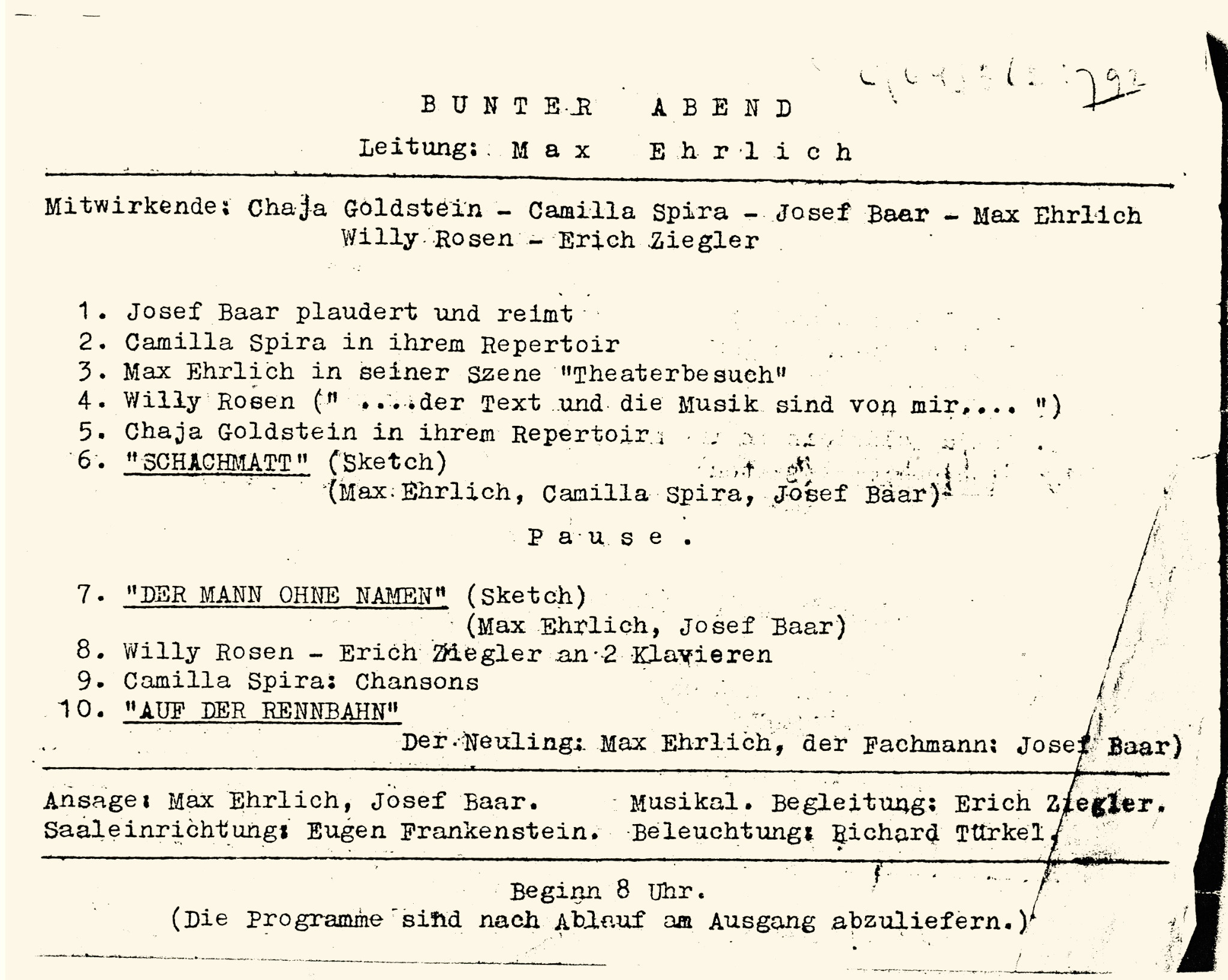
Bunter Abend I program, Westerbork, July 1943 — Max Ehrlich's personal copy.
The performers named in the
program are:
-
Chaja
Goldstein
-
Camilla
Spira
-
Josef
Baar
-
Max
Ehrlich
-
Willy
Rosen
-
Erich
Ziegler
Also named:
-
Eugen
Frankenstein,
decoration
-
Richard
Türkel, .
lighting
Die Mädel von der Hachscharah
Willy Rosen — Bunter Abend I
Music restored by Maistro Francesco Lotoro within his grand recording project and encyclopedia series
KZ Music (kzmusik.com)
Die Mädel von der Hachscharah
sind früh bis spät sehr tüchtig.
Darum ist auch die Hachscharah
für Westerbork sehr wichtig.
So'n braun gebranntes Mädel wär mein Fall,
mit roten Tuch und blauem Overall.
So'n Mädel von der Hachscharah,
das wäre meine Wonne.
Doch leider fliegt sie auf einen
von der Fliegenden Kolonne.
English meaning
The girls of the Hachshara are hard at work from early morning until late, which is why the Hachshara is so important to Westerbork. The singer says that a suntanned Hachshara girl, wearing a red scarf and blue overalls, would be exactly his type and his delight. Unfortunately, however, she has eyes for a man from the Fliegende Kolonne instead.
The Westerbork Theater Group's first production, "Bunter Abend" (Colorful Evening), is staged in July and August 1943.
Max Ehrlich is the director, but also plays a speaking role.
Essentially, the program consists of scenes taken from the repertoires of each of the individual performers.
However, one new song in particular becomes the first Westerbork hit tune: "Die Mädel von der Hachscharah" (The Girls of the Hachshara), about the girls in the Zionist workgroup by the same name in Westerbork.
The show is a big success and as a result the Theater Group gets permission to recruit further members... thereby saving a few more people from transport to the extermination camps in the East.
As stated directly on the program itself, the audience was compelled to return the program following the performance: "Die Programme sind nach Ablauf am Ausgang abzuliefern." For this first Bunter Abend, that requirement still appears to have been strictly enforced. It was apparently applied less rigorously in subsequent revues, from which more numerous examples remained in audience hands and thus survived the Holocaust.
The present copy is therefore exceptional: the sole known surviving example from this first Bunter Abend. It was Max Ehrlich's personal copy, preserved within the file he entrusted to Jaap Cantor, the 18-year-old son of his fellow Westerbork performer Jetty Cantor, to smuggle out of the camp on his behalf. Those papers resurfaced only in 2001, when Cantor, clearing out his attic, was about to discard the old yellowed sheets but was wisely advised first to enquire whether there might be any interest in them. Thus, documents that had survived Westerbork and the Holocaust came remarkably close to disappearing more than half a century later.
The program does not specifically name Die Mädel von der Hachscharah. Several musical contributions are listed only in general terms: Willy Rosen appears simply under his own name, while Camilla Spira and Chaja Goldstein are described as appearing "in ihrem Repertoire." The song is, however, independently documented as belonging to Bunter Abend I. Its absence as an individual title on this sheet therefore reflects the program's character as a concise running order rather than a complete listing of every musical number.
The program is also striking for what it lacks. Its presentation is almost entirely utilitarian: typewritten text, simple horizontal rules and virtually no graphic design whatsoever. This initial Bunter Abend is visibly still devoid of the creative design talents of Leo Kok and Hans Margules, whose work would give the programs of the subsequent Westerbork revues their far more elaborate, imaginative and professional appearance. Compared with those later productions, this first program has the character of an improvised and austere beginning to what would rapidly develop into a surprisingly sophisticated theatrical enterprise within the confines of Westerbork.
The program lists 10 scenes:
1.
Josef Baar Chats and
Rhymes
Josef
Baar plaudert und reimt
2.
Camilla Spira in her
Repertoire
Camilla
Spira in ihrem Repertoire
3.
Max Ehrlich in his
Scene "Theater Visit"
Max
Ehrlich in seiner Szene "Theaterbesuch"
4.
Willy Rosen
("...the Words and the Music are by Me...")
Willy
Rosen ("...der Text und die Musik sind von mir...")
5.
Chaja Goldstein in
her Repertoire
Chaja
Goldstein in ihrem Repertoire
6.
CHECKMATE (Sketch)
(Max Ehrlich, Camilla Spira, Josef Baar)
SCHACHMATT
(Sketch) (Max Ehrlich, Camilla Spira, Josef Baar)
7.
THE MAN WITHOUT A
NAME (Sketch) (Max Ehrlich, Josef Baar)
DER
MANN OHNE NAMEN(Sketch) (Max Ehrlich, Josef Baar)
8.
Willy Rosen - Erich
Ziegler at 2 Pianos
Willy
Rosen - Erich Ziegler an 2 Klavieren
9.
Camilla Spira: Songs
Camilla
Spira: Chansons
10.
ON THE RACE TRACK
(The Newcomer: Max Ehrlich, the Expert: Josef Baar)
AUF
DER RENNBAHN (Der Neuling: Max Ehrlich, der Fachmann: Josef Baar)