|
Stage.Appearances
|
|
‘’All the
world is a stage and we are but actors who strut and fret their
hour upon it’’
William
Shakespeare
|
| |
|
|
|
1911 |
Max Reinhardt's Theater School:
Schauspielschule des Deutschen Theaters
(Max Reinhardt's Theater School), Berlin
Classmates include other future stars: Conrad Veidt, Else Eckersberg, Fred Murnau, Ernst Lubitsch
|
| 1912-1913 |
Deutsches
Theater Berlin
Romeo und Julia
|
| |
Deutsches
Theater Berlin
Hamlet
|
| |
Deutsches
Theater Berlin
Der lebende Leichnam
|
| |
Deutsches
Theater Berlin
Molière's George Dandin
|
| |
Post Acting School Career Begins: |
| 1913-1914 |
Märkisches
Wandertheater
|
| 1914/1915 |
Theater des
Neuen Freien Bühne Berlin
|
| 1915-1920 |
Breslauer
Schauspielhaus, Breslau
|
| 1919 |
Liebichkabarett, Breslau
|
| 1920 |
Reinhardt
Deutsches
Theater Berlin
Offenbach's Schöner Helena
|
| |
Theater am Nollendorfplatz
Jettchen Gebert
|
| |
Berliner Staatsoper
Sidney Jones' Geisha
|
| |
Renaissance Theater, Berlin
Die Wunder-Bar
|
| |
Lessing Theater, Berlin
Dreimal
Hochzeit
|
| |
Cabaret Career Begins: |
| February
1922 |
Bonbonniere, Zurich
|
| May
1922 |
Simpl,
Vienna

|
| 1924 |
Hermann-Haller-Revue
Theater am Admiralspalast, Berlin
Noch und Noch
Again and Again
|
| 1925 |
Hermann-Haller-Revue,
Theater am Admiralspalast, Berlin
Achtung!
Welle 505
Attention! Wave 505
|
| 1925 |
Hermann-Haller-Revue,
Theater am Admiralspalast, Berlin
Immer
feste druff
Always Hard Hitting
|
| March-December
1926 |
Charlott
Casino, Berlin
(theater critic's
review)
|
| December
31st 1926 |
Tiergartenhof, Berlin
|
| 1927 |
Hermann-Haller-Revue
Wann und
wo
Where and When
|
| March
27th 1928 |
Lustspielhaus, Berlin
Dritter Teil des Festprogramms zu
Ehren des
50jährigen Berliner Schauspieler-Jubiläums von Guido Thielscher
Festival Program in Honor of Guido Thielscher's 50th
Anniversary as a Berlin Actor, Part 3
|
| 1928 |
Kabarett der Komiker, Berlin
Kitty Macht Karriere
Kitty's Career
(theater
critic's review 1, 2 )

|
| 1929 |
Wintergarten, Berlin
Matinee der
Prominenten
Celebrity Matinee

|
| 1929 |
Max
Reinhardt Production
Von
Monmarte zum Montklamott
From Montmatre to Montklamott
|
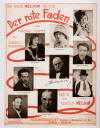
| 1930 |
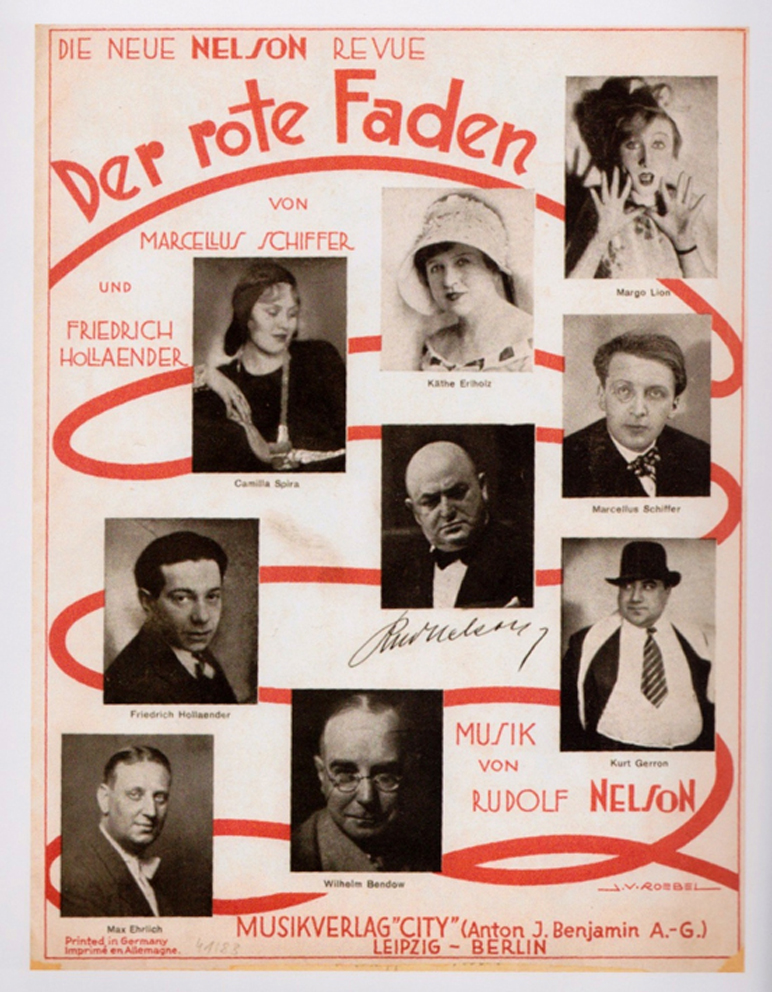
Rudolf Nelson Revue
Der rote Faden
The Guiding Line
|
| February
1931 |
Kabarettabend, Berlin
Kabaret
evening, Berlin
|
| February
23rd 1931 |
Winterhilfe Veranstaltung, Berlin
Winter Aid
Event, Berlin
|
| 1931 |
Korso Kabarett
"Dutschlands führendes Kabarett"
Kurfürstendamm 12, Berlin
Nebenbei bemerkt
(Revue)
Noted as an after thought (Revue)
|
| October
1931 |
Veranstaltung in
Berlin
Event in Berlin
|
| 1932 |
Kabarett
der Komiker, Berlin
Revue Plius
Plius Revue
|
| Autumn
1932 |
Bendows
Bunte Bühne
|
| April
1932 |
Wintergarten, Berlin
Fünf im
Käsewagen (Revue)
Five in the Cheese Truck
(Revue)
|
| 1933 |
Prague
|
| 1933 |
Karlsbad
|
| |
Rudolf
Nelson Revue: |
April 17th-19th1933
(cut short by Nazi hooligans) |
Rudolf
Nelson Revue, Ronacher Theater, Vienna
Chanson-revue:
Am Flügel
Rudolf Nelson
Rudolf Nelson at the Grand Piano
|
| Autumn
1933 |
Rudolf
Nelson Revue, Zurich
|
| May 1st-Mid-May 1934 |
Rudolf
Nelson Revue, Louis David's Leidscheplein Theater, Amsterdam
1000 Takte
Nelson
1000 Nelson Beats
|
| May 28th-June 15th 1934 |
Rudolf
Nelson Revue, Louis David's Leidscheplein Theater, Amsterdam
Etwas für Sie
Something for You
|
| End-June-July 1934 |
Kurhaus-Cabaret Scheveningen
Title
not known
(guest appearance)
<- Press Review <- Press Review |
| Summer Season 1934 |
Rudolf Nelson Revue, Scheveningen
Title
not currently known
|
| |
Other Appearances: |
| End-January
1935 |
Yugoslavia
|
| |
Jüdischer Kulturbund: |
| February
9th 1935 |
Berliner
Theater
Kleiner Faust, was nun?
What Now Little Faust?
|
| April
12-13 1935 |
Jüdischer
Kulturbund (Kubu), Berlin
Kleinkunst-Abend
Light Theater Evening
|
| August
11th
1935 |
Jüdischer
Kulturbund (Kubu), Berlin
Spiel im
Schloss
Game in the Castle
|
| October
29th 1935 |
Kleinkunstbühne
Café Leon, Lehniner Platz, Berlin
Eröffnung der Kleinkunstbühne der
Kulturdundes
Opening of the Kulturbund's Light Theater Stage
|
| December
3rd 1935 |
Kleinkunstbühne
Café Leon, Lehniner Platz, Berlin
Kunterbunt
(Revue)
Colorful (Revue)
|
| February
4th 1936 |
Kleinkunstbühne
Café Leon, Lehniner Platz, Berlin
Herr Direktor-bitte Vorschuss
Mr. Director-A Pay Advance Please
|
| April
1936 |
Brüdervereinshaus,
Berlin
Everything Revolves Around Helena
Alles
dreht sich um Helena
|
| 2nd-3rd
May 1936 |
Jüdischer
Kulturbund (Kubu), Düsseldorf
(Guest appearance)
|
| June
1936 |
Kleinkunstbühne
Café Leon, Lehniner Platz, Berlin
(guest appearance of the Hamburg Jüdischer Kulturbund Ensemble)
Meine Schwester und ich
My Sister and Me
|
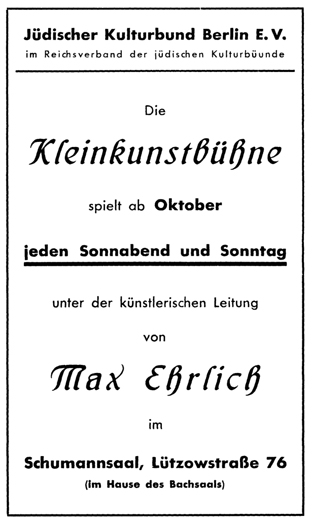
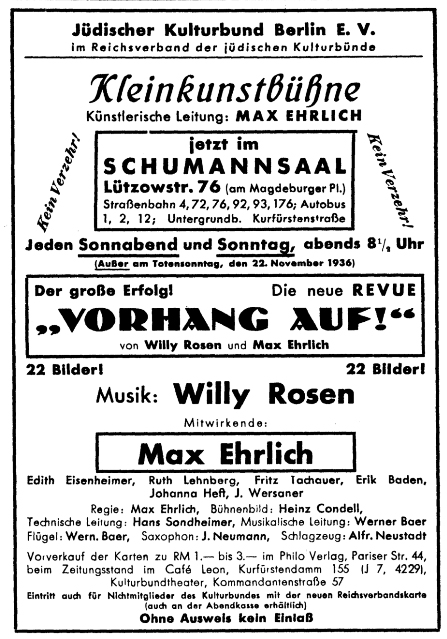
| October 3rd-December 31st 1936 |
Kleinkunstbühne
Schumann-Saal, Lützowstrasse, Berlin
Vorhang
Auf!
Curtain Up!


|
| November
1936 |
Jüdischer
Kulturbund (Kubu), Hamburg
Vorhang
Auf!
Curtain Up!
(guest appearance with the Berlin revue)
|
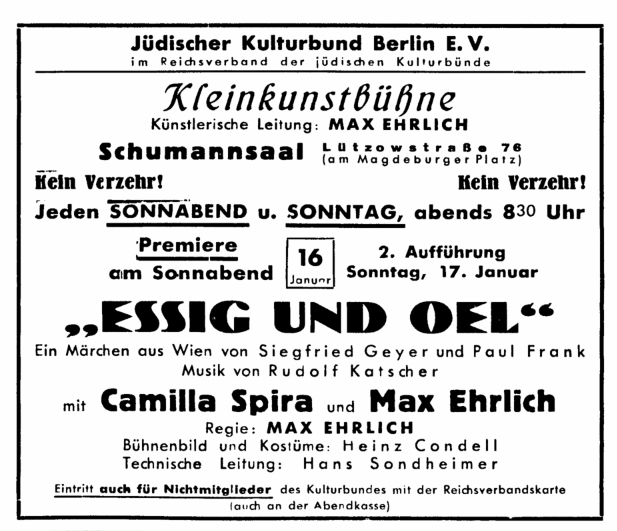
January
16th-17th 1937
|
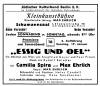
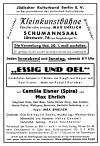
Kleinkunstbühne
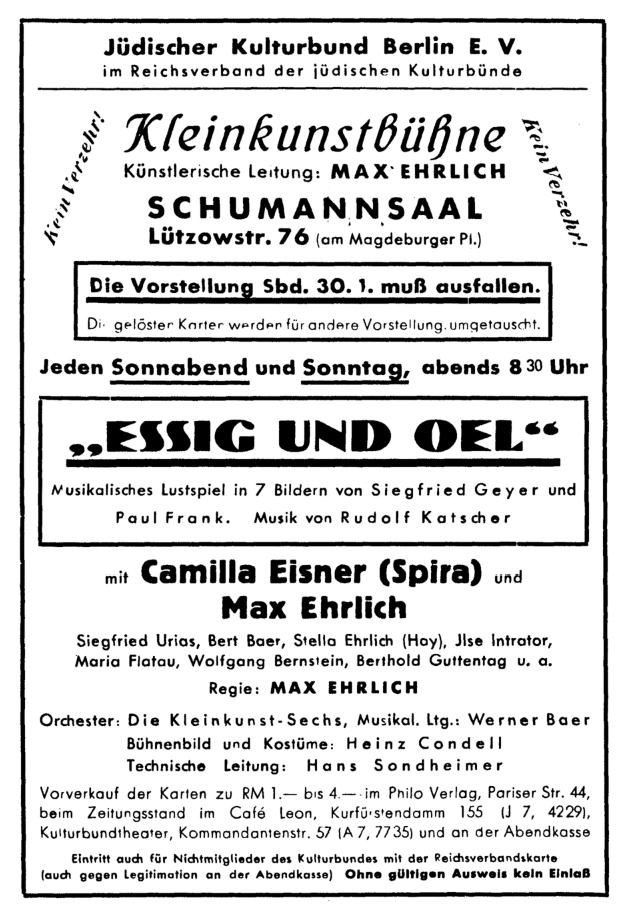
Schumann-Saal, Lützowstrasse, Berlin
Essig und Öl
Vinegar and Oil

|
February 15th-16th 1937
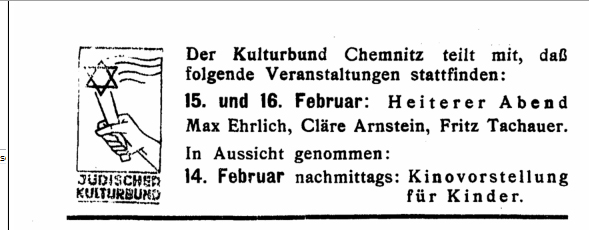
|
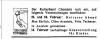
Kulturbund Chemnitz
Heiterer Abend
Merry Evening
|
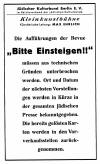
| March
28th-April 1937 |
Kleinkunstbühne
Logenhaus, Kleiststrasse, Berlin
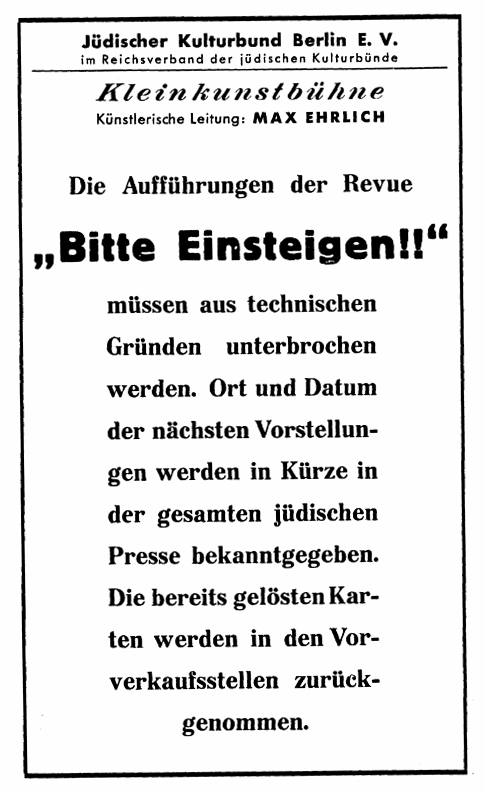
Bitte einsteigen!
All Aboard!
|
| April
1937 |
Jüdischer
Kulturbund (Kubu), Hamburg
(guest appearance with the Berlin revue)
Herr Direktor-bitte Vorschuss
Mr. Director-A Pay Advance Please
|
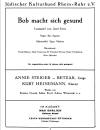
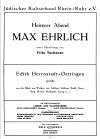
| August
1937 |
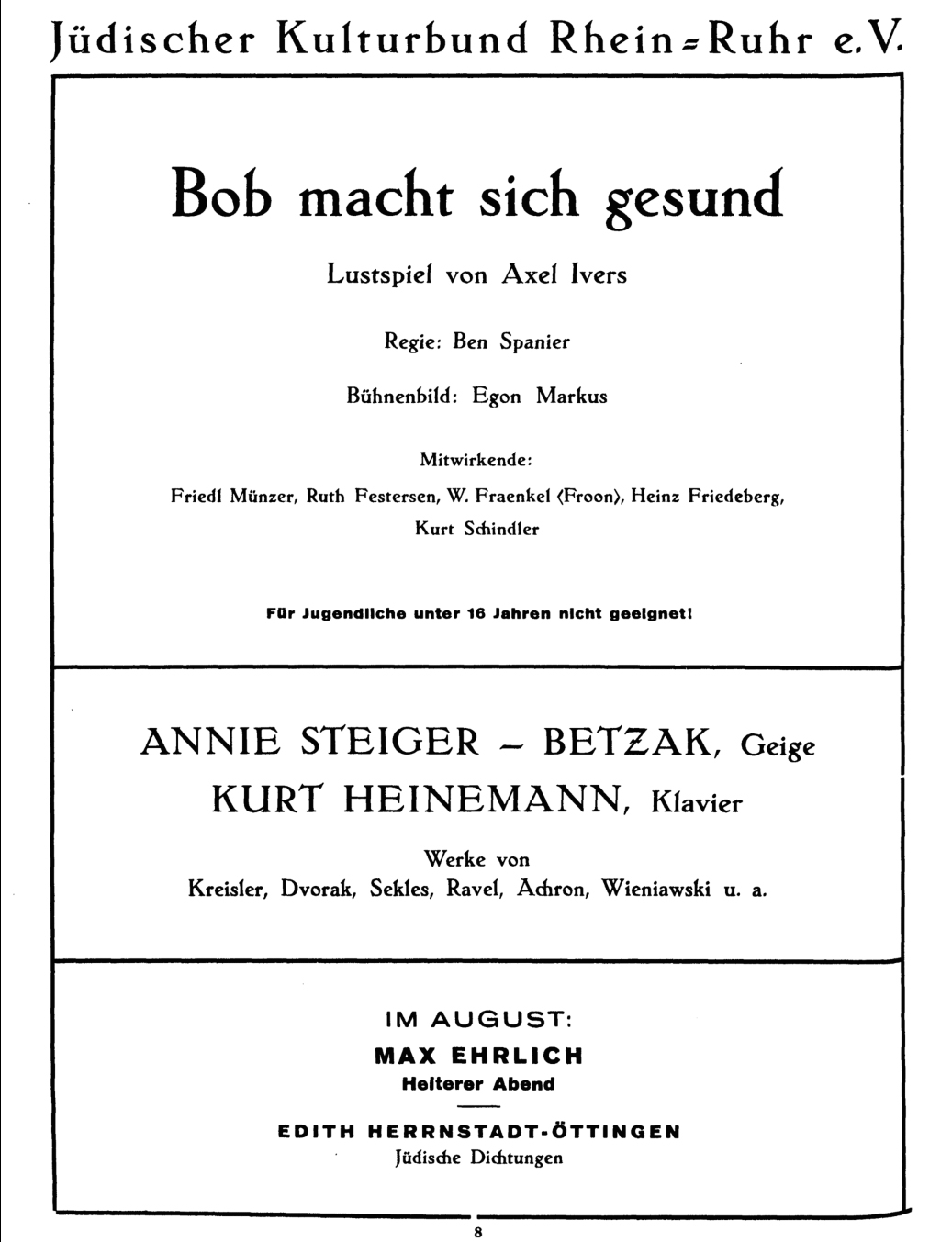
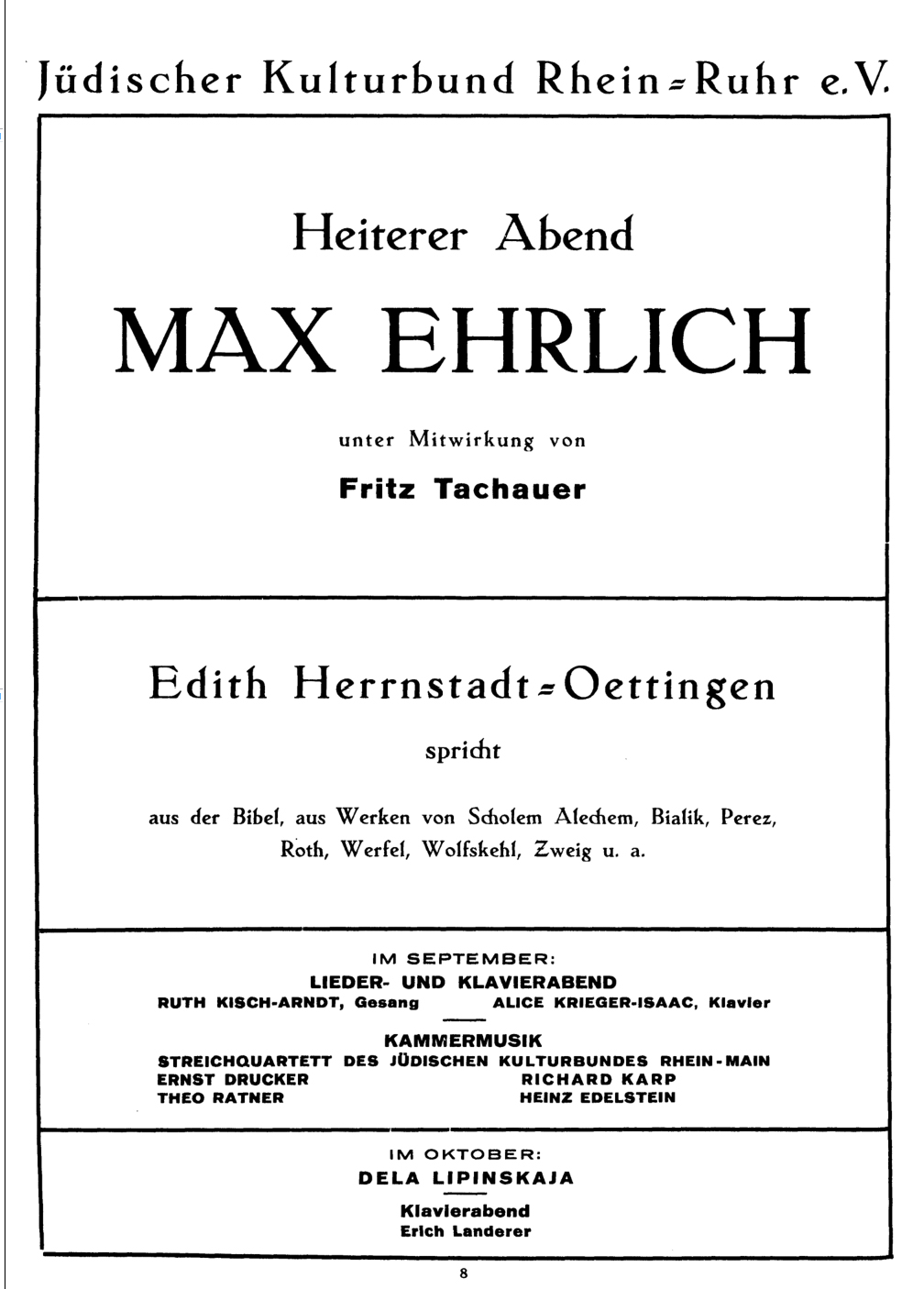
Jüdischer
Kulturbund (Kubu), Rhein-Ruhr
Heiterer Abend
Merry Evening
(Guest appearance)
|
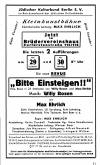
May 29th-30th 1937
|
Bruedervereinsthaus Kurfuerstenstrasse
Bitte einsteigen!
All Abord!
|
| December
1937 |
Kleinkunstbühne
im neuen Kulturbundsaal, Kommandantenstrasse, Berlin
Von Romeo
bis Streichquartett
From Romeo to String Quartette
|
| March
1938 |
Kleinkunstbühne
Kulturbundsaal, Kommandantenstrasse, Berlin
Warum lügst du Cherie?
Why are You Lieing, Darling?
|
| April
1938 |
Theater der
Jüdschen Schulen, Berlin
Das Extemporale
The Extempore
|
| April
1938 |
Jüdischer
Kulturbund (Kubu), Hamburg
(guest appearance with the Berlin revue)
Von Romeo
bis Streichquartett
From Romeo to String Quartette
|
| June
1938 |
Jüdischer
Kulturbund (Kubu), Berlin
Die Schöne Helena
Beautiful Helen
|
| July
1938 |
Jüdischer
Kulturbund (Kubu), Berlin
Drei
Einakten Courtelines
Three One Act Courtelines
|
| August
1938 |
Jüdischer
Kulturbund (Kubu), Berlin
Arm wie
eine Kirchenmaus
Poor as a Church Mouse
|
| August
1938 |
Jüdischer
Kulturbund (Kubu), Rhein-Ruhr
Arm wie
eine Kirchenmaus
Poor as a Church Mouse
(guest appearance)
|
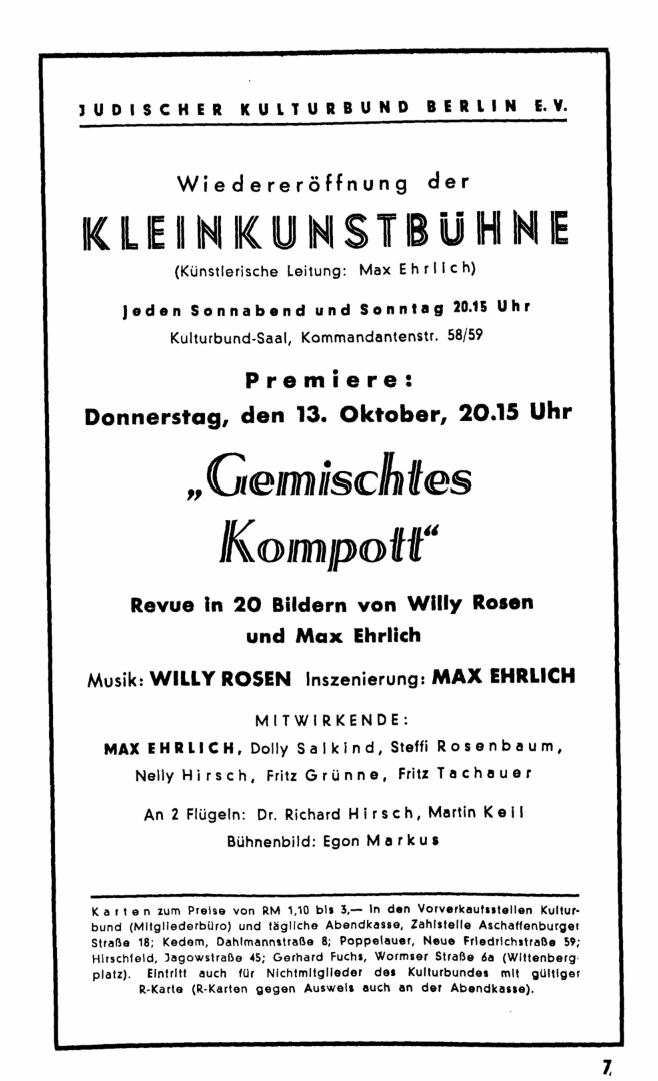
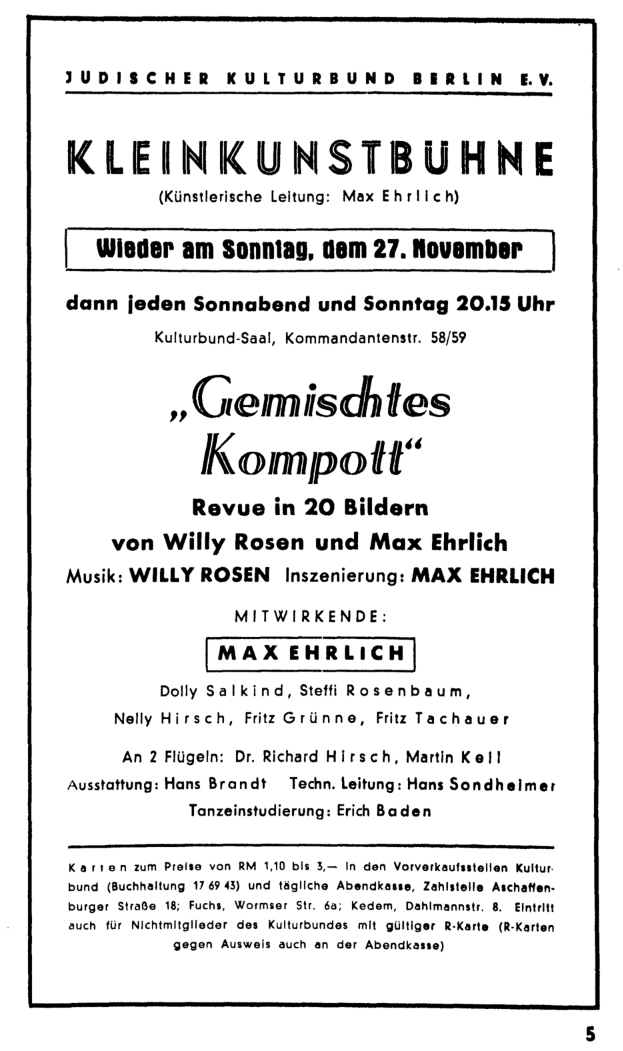
| October 13th-December 1938 |
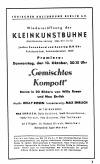
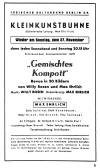
Kleinkunstbühne
Kulturbundsaal, Kommandantenstrasse, Berlin
Gemischtes Kompott
Mixed Compote
|
| February
1939 |
Jüdischer
Kulturbund (Kubu), Berlin
Shakespeares, Wintermärchen
Shakespeare's, A Winter's Tale
|
March 3rd-
April 2nd 1939
(Final appearance in Germany) |
Kulturbundtheater, Berlin
Revue der Revuen
Revue of Revues
|
| |
Dutch Exile:
|
| May 18th 1939 (Premier) |
Willy
Rosen's Prominenten Cabaret, Spa Season in Scheveningen
Volle kracht vooruit
Full Steam Ahead
|
| June
8th 1939 (Premier) |
Willy
Rosen's Prominenten Cabaret,
Summer Season in the Lutine Palace, Scheveningen
1000 Worte Humor or Juist verschenen
1000 Words of Humor or Latest News

|
| July 1st 1939 (Premier) |
Willy
Rosen's Prominenten Cabaret,
Summer Season in the Lutine Palace, Scheveningen
Melodie des Lachens
Laughter's Melody
|
| July 25th 1939 (Premier) |
Willy
Rosen's Prominenten Cabaret,
Summer Season in the Lutine Palace, Scheveningen
Tempo! Tempo!
Tempo! Tempo!
(Co-directed by
Willy Rosen & Max Ehrlich)
 <-
Press Review <-
Press Review
▶ English translation of the review
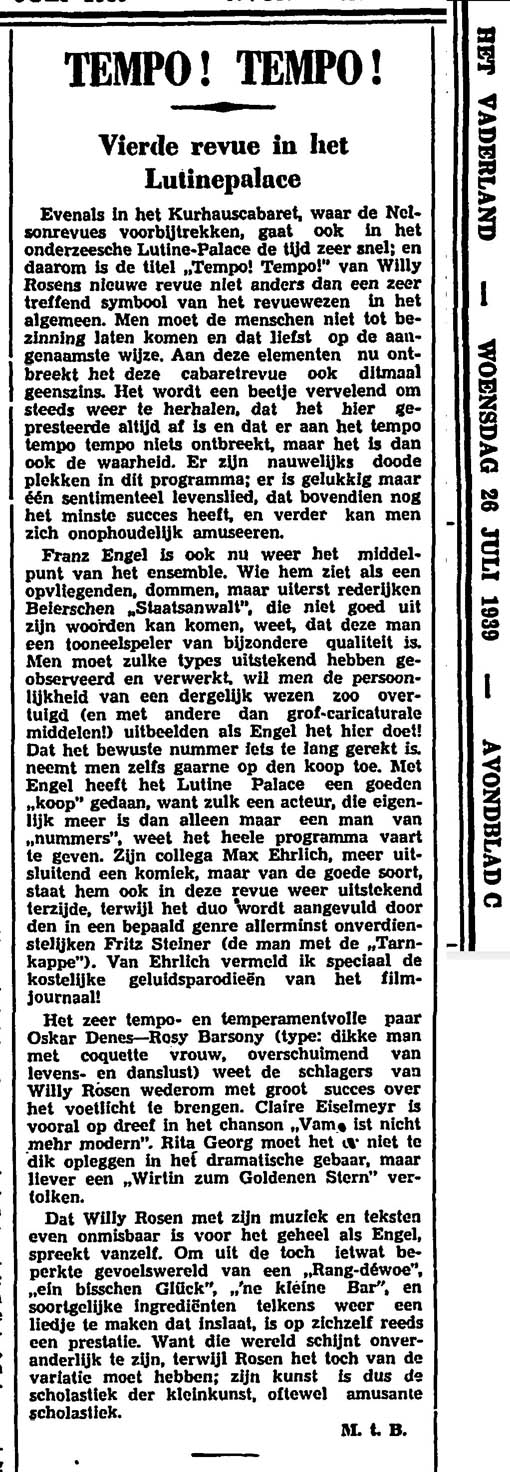
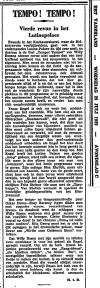
Tempo! Tempo!
Fourth revue at the Lutine Palace
As at the Kurhaus Cabaret, where the Nelson revues pass in quick succession, time also moves very quickly in the undersea Lutine Palace; and so the title Tempo! Tempo! of Willy Rosen's new revue is nothing less than a very apt symbol of the revue form in general. One must not let the audience stop to reflect, and preferably do so in the most agreeable way possible. Once again, this cabaret revue is certainly not lacking in those qualities.
It is becoming a little tiresome to have to repeat that everything presented here is always thoroughly polished and that nothing is missing from the tempo, tempo, tempo, but it is simply the truth. There are hardly any dead spots in this program; fortunately there is only one sentimental ballad, and that is also the least successful number, while otherwise one can be continuously entertained. Franz Engel is once again the center of the ensemble.
Anyone who sees him as a hot-tempered, stupid, yet exceedingly talkative Bavarian "public prosecutor" who nevertheless cannot quite get his words out knows that this man is an actor of exceptional quality. One must have observed and absorbed such types extraordinarily well to portray the personality of such a creature as convincingly as Engel does here, and by means other than crude caricature! One even gladly accepts that this particular number is stretched a little too long.
With Engel, the Lutine Palace has made a good acquisition, for an actor like this, who is really more than merely a performer of "numbers," knows how to give the whole program momentum. His colleague Max Ehrlich, more exclusively a comedian, but a very good one, once again supports him splendidly in this revue, while the duo is rounded out by Fritz Steiner, who is by no means without merit in his particular genre (the man with the "Tarnkappe," or magic cap).
Of Ehrlich I should particularly mention his delightful sound parodies of the film newsreel! The very fast-paced and temperamental pair Oskar Denes and Rosy Barsony (the type: stout man with coquettish wife, overflowing with zest for life and dancing) once again put Willy Rosen's hit songs across with great success. Claire Eiselmeyr is especially in her element in the chanson Vam, ist nicht mehr modern.
Rita Georg should not lay the dramatic gestures on too thickly, but would do better to play a Wirtin zum Goldenen Stern. That Willy Rosen, with his music and texts, is as indispensable to the whole as Engel goes without saying. To keep making a song that catches on out of the somewhat limited emotional world of a Rang-dewoe, ein bisschen Gluck, 'ne kleine Bar, and similar ingredients is in itself an achievement.
For that world seems unchanging, while Rosen nevertheless depends on variation; his art is therefore the scholasticism of cabaret, or, in other words, entertaining scholasticism. — M.t.B.
Source: Menno ter Braak, Het Vaderland, 26 July 1939. Original Dutch article.
English translation prepared for the Max Ehrlich Association archive, 2026.
|
August 16th 1939 (Premier) |
Willy
Rosen's Prominenten Cabaret,
Summer Season in the Lutine Palace, Scheveningen
Schevenigen Lacht
Schevenigen Laughs
 <-
Press Review <-
Press Review
▶ English translation of the review
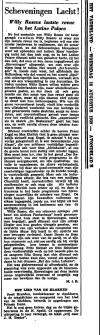
Scheveningen Lacht!
Willy Rosen's final revue at the Lutine Palace
Now that Willy Rosen's ensemble (or rather, the ensemble surrounding Willy Rosen) has already reached its last revue, we begin, not without regret, to realize that summer is well advanced and that Scheveningen will soon stop laughing again. For the moment, however, it is still laughing, and this time at the Lutine Palace it laughs with all its heart, even though they unashamedly pronounce the name as "Sjeveningen" so as not to trip over their own tongues.
The word "Scheveningen," as everyone knows, is the shibboleth of the Dutch; anyone who cannot pronounce that word and the word "Spui" impeccably still betrays himself as a foreigner in our Jerusalem. The people around Willy Rosen, however, have no wish to pose as pseudo-Dutchmen, only as agreeable guests, and so they make no effort to pronounce the name of their revue correctly. That does not make them any less energetic in their campaign of laughter.
Anyone who enjoys this kind of revue-cabaret will find here an excellent example of a light and highly varied sequence of sketches, songs and anecdotes, put across with an unsurpassable sense of pace. An "experiment" such as the sketch Im Restaurant best shows the appealing level these texts can reach. This time, however, Messrs. Franz Engel and Max Ehrlich, and this is no empty phrase, really surpass even themselves.
Engel, as I wrote on an earlier occasion, is an actor "of class," possessing a rare versatility even in this cabaret art, although the serious stage would surely suit him no less well. One must see him, for example, in Der Regenschirm, carried over from a previous program into this new one, to appreciate his qualities fully; the sly tenacity with which, as an apparently simple-minded man, he brings his innocent opponent to his knees is superbly acted. But this actor, who has something of a plump Churchill about him, is also unsurpassed as an impersonator, and as a master of ceremonies he is no less effective.
As an impersonator, however, Ehrlich draws level with him, and indeed throughout the whole "Sjeveningen" program he is scarcely inferior to Engel. The two gentlemen are also perfectly attuned to one another, as is evident, among other things, from their work together in an imitation act, one of the most delightful numbers.
Willy Rosen, who has composed a new hit, Ich kenn' ein kleines Fischerhaus (the house is in "Sjeveningen," as one might expect), this time joins his colleague Ziegler, seated at their golden grand pianos, in a survey of his past as a composer for the lighter muse (and in that respect he has had a very eventful past). Oskar Denes and Rosy Barsony are also back, and although in my opinion their numbers are not quite as amusing as on previous occasions, their pace is irresistible enough.
Fritz Steiner and Otto Schnitzer do commendable work in supporting roles, and the singer Rita Georg also shows her best side this time, especially as an "Apache" woman in the chanson Bei der roten Laterne. Last night was already sold out, and the mood was as cheerful as the floral tributes were abundant. "Sjeveningen" will undoubtedly pay this final revue as much honor as the previous ones, if not more. — M.t.B.
Translator's note: "Apache" here is the period European cabaret term for a Parisian-underworld character.
Source: Menno ter Braak, Het Vaderland, 16 August 1939. Original Dutch article.
English translation prepared for the Max Ehrlich Association archive, 2026.
|
| 14th April 1941 |
De Kamerspielers
Muzieklyceum
Alb. Hahnplantsoen 2-4, Amsterdam
Hun Tweede Cabaret-Programma
Their Second Cabaret Program

|
| May-July
6th 1941 |
Willy
Rosen's Prominenten
Cabaret, Amsterdam
Hollandsche Schouwburg, Amsterdam
Spiel im Schloss
Play in the Castle
(Directed by Max Ehrlich)


|
| July
12th-Late August 1941 |
Willy
Rosen's Prominenten Cabaret
Hollandsche Schouwburg, Amsterdam
Die Fee
The Fairy
(Directed by Max Ehrlich)

|
| November
8th-28th 1941 |
Willy
Rosen-Revue
Theater van der Lach, Amsterdam
Luna-Park
Amusement Park
(Max Ehrlich, Guest Star)

|
| November
29th-December 18th 1941 |
Willy
Rosen-Revue
Theater van der Lach, Amsterdam
Confetti
Confetti
(Max Ehrlich, Guest Star
|
| December
25th-28th 1941 |
Theater
van der Lach, Amsterdam
Groote Kinderrevue
Grand Revue for Children
|
| December
24th 1941-January 9th 1942 |
Willy
Rosen-Revue
Theater van der Lach, Amsterdam
Allemal op de fiets!
Everything on the bicycle!
|
| January
17th-February 13th 1942 |
Willy
Rosen-Revue
Theater van der Lach, Amsterdam
Carnaval
Carnaval
|
| February
14th-April 22nd 1942 |
Willy
Rosen Presenteert een Operette
Theater van der Lach, Amsterdam
Chaste Suzanna
De Kuische Suzanna
|
| Mid
May-Mid June 1942 |
Rudolf
Nelson Revue
Joodsche Schouwburg, Amsterdam (name after the German occupation)
Sensatie!
Sensation!
(Directed by May Ehrlich)
|
| June
20th-July 17th 1942 |
Joodsche
Kleinkunst Ensemble, Amsterdam
Joodsche Schouwburg, Amsterdam (name after the German occupation)
Vuurwerk
Commotion
(Directed by Max Ehrlich)
|
July
18th-25th 1942
(last performance found advertised
in Het
Joodsche Weekblad was for
July 25th 1942) |
Joodsche
Kleinkunst Ensemble, Amsterdam
Joodsche Schouwburg, Amsterdam (name after the German occupation)
Dat Smaakt
That Tastes Good
(Directed by May Ehrlich)
|
| |
Westerbork Concentration Camp: |
| July-August
1943 |
Westerbork
Concentration Camp
Bunter Abend (1)
Colorful Evening (1)
|
| September
1943 |
Westerbork
Concentration Camp
Humor und
Melodie
Humor and Melody
|
| October
1943 |
Westerbork
Concentration Camp
Bravo! Da Capo
Hail to the Chief!
|
| November
1943 |
Westerbork
Concentration Camp
Bunter Abend (2)
Colorful Evening (2)
|
| April
1944 |
Westerbork
Concentration Camp
Bunter Abend (3)
Colorful Evening (3)
|
| June
1944 |
Westerbork
Concentration Camp
Total Verrückt
Totally Insane
|